

Idioms are an integral part of the English language, adding color, depth, and nuance to our everyday conversations. Understanding and using idioms effectively can significantly enhance your fluency and comprehension.
This article focuses specifically on idioms related to the home, a topic universally relatable and rich with figurative language. Whether you’re a student learning English, a professional seeking to improve your communication skills, or simply an enthusiast eager to expand your linguistic repertoire, this guide will provide you with a comprehensive overview of home-related idioms, complete with definitions, examples, and practice exercises.
By exploring these idioms, you’ll gain a deeper understanding of English cultural expressions and be better equipped to navigate conversations with native speakers. This knowledge will enrich your understanding of books, movies, and other media, making your learning journey more enjoyable and rewarding.
Let’s dive into the cozy world of idioms about home!
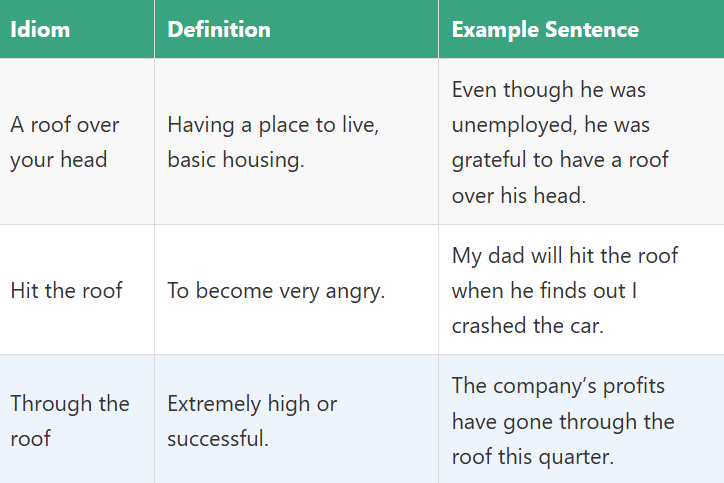
Table of Contents
- Definition of Idioms for Home
- Structural Breakdown
- Types and Categories of Home Idioms
- Examples of Home Idioms
- Usage Rules for Home Idioms
- Common Mistakes with Home Idioms
- Practice Exercises
- Advanced Topics
- FAQ
- Conclusion
Definition of Idioms for Home
An idiom is a phrase or expression whose meaning cannot be understood from the literal meanings of the individual words. Instead, idioms rely on a figurative or symbolic interpretation that has evolved over time through cultural usage.
Idioms add color and expressiveness to language, allowing speakers to convey complex ideas or emotions in a concise and memorable way. Idioms related to “home” specifically use the concept of a house, dwelling, or family environment to represent broader themes, feelings, or situations.
These can range from describing personal comfort and security to expressing societal values and expectations.
Home-related idioms are often used to describe feelings of belonging, security, or nostalgia. They can also be used to comment on social issues, family dynamics, or personal experiences.
The power of these idioms lies in their ability to evoke strong imagery and emotions, making communication more engaging and impactful. Understanding these idioms is crucial for comprehending spoken and written English, as well as for effectively communicating with native English speakers.
Classification of Idioms
Idioms can be classified based on their structure, function, or the thematic area they cover. In the context of home-related idioms, we can classify them based on the specific aspect of “home” they relate to, such as:
- Physical Structure: Idioms related to the actual building or parts of a house.
- Family and Relationships: Idioms focusing on family dynamics and relationships within the home.
- Comfort and Security: Idioms describing feelings of safety, warmth, and well-being associated with home.
- Social and Cultural Aspects: Idioms reflecting societal values and cultural norms related to home and family life.
Function of Idioms
Idioms serve several key functions in communication:
- Expressiveness: They add color and vividness to language, making it more engaging.
- Conciseness: They can convey complex ideas or emotions in a short, memorable phrase.
- Cultural Understanding: They provide insights into the cultural values and beliefs of a language community.
- Informality: They often create a more relaxed and conversational tone.
Contexts for Idiom Usage
Home-related idioms are used in a variety of contexts, including:
- Everyday Conversation: Informal discussions about family, living arrangements, or personal experiences.
- Literature: Novels, poems, and short stories often use idioms to add depth and authenticity to characters and settings.
- Media: Movies, TV shows, and news articles may use idioms to connect with audiences and convey specific messages.
- Professional Settings: While less common, idioms can sometimes be used in business communication to build rapport or make a point informally.
Structural Breakdown
Understanding the structure of idioms is essential for recognizing and interpreting them correctly. Idioms often defy the typical grammatical rules and semantic expectations of the language.
Here’s a breakdown of the structural elements commonly found in home-related idioms:
Structural Elements
Home idioms can be composed of various parts of speech and grammatical structures. Here are some common elements:
- Nouns: Words representing objects, places, or concepts related to home (e.g., roof, hearth, walls).
- Verbs: Actions or states of being associated with home life (e.g., build, settle, nest).
- Adjectives: Describing qualities or characteristics of the home or its inhabitants (e.g., cozy, safe, welcoming).
- Prepositions: Indicating relationships between elements within the home (e.g., under the roof, within the walls).
- Phrases: Combinations of words that form a single unit of meaning (e.g., home sweet home, make yourself at home).
Idiomatic Patterns
Certain patterns tend to recur in home-related idioms:
- Metaphor: Using a concrete image of home to represent an abstract idea (e.g., a roof over your head symbolizing basic security).
- Simile: Comparing something to home to emphasize its qualities (e.g., snug as a bug in a rug).
- Personification: Giving human qualities to the home or its features (e.g., the walls have ears).
Grammatical Rules
Idioms often break conventional grammatical rules. It’s important to remember that the meaning of an idiom is not derived from the literal interpretation of the individual words, but rather from the established figurative meaning.
Types and Categories of Home Idioms
Home-related idioms can be categorized based on the specific aspect of home life they represent. This categorization helps in understanding the nuances of each idiom and its appropriate usage.
Physical Structure Idioms
These idioms relate to the physical components of a house, such as walls, roof, and foundation. They often symbolize stability, security, and protection.
Family Relationships Idioms
These idioms focus on the dynamics and relationships within a family unit. They can describe love, conflict, support, and other aspects of family life.
Comfort and Security Idioms
These idioms express feelings of safety, warmth, and well-being associated with home. They often evoke a sense of peace and contentment.
Social and Cultural Idioms
These idioms reflect societal values and cultural norms related to home and family life. They often comment on social expectations, traditions, and beliefs.
Examples of Home Idioms
Here are extensive examples of home-related idioms, categorized for clarity. Each example is accompanied by a definition and an illustrative sentence.
Physical Structure Idioms Examples
The following table provides examples of idioms related to the physical structure of a home. These idioms often symbolize stability, security, and protection.
| Idiom | Definition | Example Sentence |
|---|---|---|
| A roof over your head | Having a place to live, basic housing. | Even though he was unemployed, he was grateful to have a roof over his head. |
| Hit the roof | To become very angry. | My dad will hit the roof when he finds out I crashed the car. |
| Through the roof | Extremely high or successful. | The company’s profits have gone through the roof this quarter. |
| Walls have ears | Be careful what you say, someone might be listening. | Don’t discuss sensitive information here; remember, walls have ears. |
| Build castles in the air | To make plans that are not realistic or likely to happen. | He spends all his time building castles in the air instead of looking for a job. |
| A house of cards | A plan or system that is very weak and could easily fail. | Their business plan was like a house of cards, easily collapsing under pressure. |
| Bring the house down | To cause a great sensation; to get a lot of applause. | The comedian really brought the house down with his hilarious jokes. |
| Clean house | To get rid of unwanted or unnecessary things or people. | The new manager decided to clean house and fire several underperforming employees. |
| Get on like a house on fire | To quickly become good friends. | We got on like a house on fire when we first met at the conference. |
| Home is where the heart is | Your true home is wherever you feel most happy and comfortable. | Even though I’ve traveled the world, home is where the heart is, and that’s with my family. |
| Make yourself at home | To feel comfortable and relaxed in someone else’s home. | Come in, make yourself at home, and I’ll get you a drink. |
| On the house | Free; paid for by the establishment. | Your first drink is on the house as a welcome gift. |
| A room with a view | A pleasant or scenic outlook from a room. | We booked a room with a view overlooking the ocean. |
| Behind closed doors | In private; secretly. | The negotiations were conducted behind closed doors. |
| Drive someone up the wall | To irritate or annoy someone very much. | His constant complaining is driving me up the wall. |
| Go through the roof | To increase to a very high level. | The price of gasoline has gone through the roof lately. |
| Keep the wolf from the door | To have enough money to avoid starvation or serious poverty. | He worked two jobs to keep the wolf from the door. |
| Like a fish out of water | To feel uncomfortable or out of place in a particular situation. | I felt like a fish out of water at the formal dinner party. |
| Near the knuckle | Risqué or indecent. | His jokes were a bit near the knuckle for a family audience. |
| Paper over the cracks | To hide problems or difficulties instead of dealing with them properly. | The government is just papering over the cracks in the healthcare system. |
| Rock the boat | To cause trouble or disrupt a stable situation. | I don’t want to rock the boat by suggesting changes to the project. |
| Sweep something under the rug | To hide something embarrassing or damaging. | They tried to sweep the scandal under the rug, but it was eventually exposed. |
| The writing is on the wall | A sign that something bad is going to happen. | The company’s declining sales were a clear sign that the writing was on the wall. |
| Turn the tables | To reverse a situation; to gain an advantage over someone who previously had an advantage over you. | She turned the tables on her opponent with a surprise attack. |
Family Relationships Idioms Examples
The following table lists idioms related to family relationships and dynamics within the home. These idioms often describe love, conflict, support, and other aspects of family life.
| Idiom | Definition | Example Sentence |
|---|---|---|
| Tie the knot | To get married. | They decided to tie the knot after dating for five years. |
| Wear the pants in the family | To be the dominant or controlling person in a relationship. | Everyone knows she wears the pants in the family. |
| Like two peas in a pod | Very similar or close to each other. | The twins are like two peas in a pod; they do everything together. |
| Blood is thicker than water | Family relationships are stronger than relationships with others. | Despite their disagreements, blood is thicker than water, and they always support each other. |
| Run in the family | To be a common trait or characteristic among family members. | Musical talent seems to run in the family; everyone plays an instrument. |
| An apple doesn’t fall far from the tree | Children tend to resemble their parents in character. | He’s a successful businessman, just like his father; the apple doesn’t fall far from the tree. |
| Birds of a feather flock together | People who are similar tend to associate with each other. | The athletes all hang out together; birds of a feather flock together. |
| Home away from home | A place where you feel as comfortable as you do in your own home. | The community center is a home away from home for many of the local kids. |
| Keep it in the family | To keep something secret or private within the family. | Let’s keep this issue in the family and not involve outsiders. |
| Like father, like son | Sons tend to behave in a similar way to their fathers. | He’s a talented musician, like father, like son. |
| Mend fences | To restore friendly relations after a disagreement. | They need to mend fences after their argument at the family reunion. |
| Put down roots | To settle down and make a place your home. | After years of traveling, they decided to put down roots in a small town. |
| Rule the roost | To be in charge or control things. | She rules the roost in her department and makes all the important decisions. |
| The black sheep of the family | A member of a family who is considered a disgrace or an outcast. | He’s always been the black sheep of the family, causing trouble wherever he goes. |
| Wear your heart on your sleeve | To openly show your feelings. | She wears her heart on her sleeve and is always honest about her emotions. |
| Born with a silver spoon in your mouth | Born into a wealthy family. | He was born with a silver spoon in his mouth and never had to work a day in his life. |
| Carry the torch | To continue a tradition or belief. | She’s carrying the torch for her family’s business. |
| Feather your nest | To enrich oneself, often dishonestly. | He was accused of feathering his nest while in office. |
| From rags to riches | To go from being poor to being wealthy. | His story is a classic example of someone who went from rags to riches. |
| Keep up with the Joneses | To try to match the possessions and lifestyle of your neighbors. | They’re always trying to keep up with the Joneses, buying the latest gadgets. |
| Leave the nest | To leave your parents’ home and start living independently. | All of her children have left the nest and started their own families. |
| Like a cat on a hot tin roof | Very nervous or restless. | He was like a cat on a hot tin roof waiting for the test results. |
| Make ends meet | To have just enough money to pay for the necessities. | It’s difficult to make ends meet with the rising cost of living. |
| Nest egg | Savings for the future. | She’s been building a nest egg for her retirement. |
| Tighten your belt | To spend less money because you have less than you used to. | We’ll have to tighten our belts during this economic downturn. |
Comfort and Security Idioms Examples
The table below presents idioms that express feelings of safety, warmth, and well-being associated with home.
| Idiom | Definition | Example Sentence |
|---|---|---|
| Home sweet home | A saying expressing joy at returning to one’s home. | After a long trip, it’s good to be back home sweet home. |
| Snug as a bug in a rug | Very comfortable and cozy. | Wrapped in a blanket by the fire, he felt as snug as a bug in a rug. |
| At home | Feeling comfortable and relaxed. | I feel completely at home when I’m with my family. |
| Make yourself at home | To feel comfortable and relaxed in someone else’s home. | Come in, make yourself at home, and I’ll get you a drink. |
| Comfort zone | A situation where one feels safe and comfortable. | She stepped outside her comfort zone and tried public speaking. |
| Behind the eight ball | In a difficult or unfavorable situation. | He’s behind the eight ball with his debts. |
| Bite the bullet | To face a difficult or unpleasant situation with courage. | I had to bite the bullet and tell him the truth. |
| Call it a day | To stop working on something. | After working for ten hours, I decided to call it a day. |
| Cut to the chase | To get to the point quickly. | Let’s cut to the chase and discuss the main issue. |
| Easy street | A state of financial comfort. | Winning the lottery put him on easy street. |
| Get a grip | To control your emotions. | You need to get a grip and stop panicking. |
| Hit the hay | To go to bed. | I’m exhausted; I’m going to hit the hay. |
| In the lap of luxury | In a state of great comfort and wealth. | They live in the lap of luxury with their private jet and mansion. |
| Keep your chin up | To stay positive and optimistic. | Keep your chin up; things will get better. |
| Let your hair down | To relax and enjoy yourself. | It’s time to let your hair down and have some fun. |
| Piece of cake | Very easy. | The exam was a piece of cake. |
| Put your feet up | To relax. | After a long day, I just want to put my feet up and watch TV. |
| Take a load off | To relax. | Come in and take a load off; you look tired. |
| Under the weather | Feeling unwell. | I’m feeling a bit under the weather today. |
| Walking on eggshells | Being very careful not to offend someone. | I have to walk on eggshells around my boss. |
| A perfect storm | A combination of events that creates a very bad situation. | The economic crisis was a perfect storm of bad decisions. |
| Bury the hatchet | To make peace after a conflict. | It’s time to bury the hatchet and move on. |
| Call a spade a spade | To speak frankly and honestly. | Let’s call a spade a spade; this project is a failure. |
| Cross that bridge when you come to it | Deal with a problem when it arises. | We’ll cross that bridge when we come to it. |
| Don’t count your chickens before they hatch | Don’t assume success before it happens. | Don’t count your chickens before they hatch; wait until the deal is finalized. |
Social and Cultural Idioms Examples
This table provides idioms that reflect societal values and cultural norms related to home and family life.
| Idiom | Definition | Example Sentence |
|---|---|---|
| Charity begins at home | One should take care of their family and close community before helping others. | They always support local causes; charity begins at home. |
| A man’s home is his castle | One’s home is their private sanctuary, where they have control. | He values his privacy; a man’s home is his castle. |
| East, west, home is best | There’s no place like home. | After traveling the world, I realized east, west, home is best. |
| Add insult to injury | To make a bad situation even worse. | To add insult to injury, they charged me a late fee on top of the original bill. |
| Barking up the wrong tree | To be mistaken or misguided in your approach. | If you think he’s the one who stole your wallet, you’re barking up the wrong tree. |
| Beat around the bush | To avoid talking directly about something. | Stop beating around the bush and tell me what you really think. |
| Best of both worlds | To have the advantages of two different things at the same time. | Living in the suburbs offers the best of both worlds: peace and quiet with easy access to the city. |
| Burn bridges | To damage relationships irreparably. | He burned bridges when he left the company without giving notice. |
| Caught between a rock and a hard place | Faced with two equally difficult choices. | I’m caught between a rock and a hard place; I don’t want to offend either of them. |
| Devil’s advocate | Someone who argues against a proposal to test its validity. | I’m just playing devil’s advocate to make sure we’ve considered all the angles. |
| Elephant in the room | An obvious problem that no one wants to discuss. | The elephant in the room is the company’s financial troubles. |
| Fool’s errand | A task that has no hope of success. | Trying to convince him to change his mind is a fool’s errand. |
| Get something off your chest | To express something that has been bothering you. | I need to get something off my chest; I’ve been feeling guilty about lying to you. |
| Head in the clouds | Not paying attention to reality. | He has his head in the clouds and doesn’t realize the seriousness of the situation. |
| Jump on the bandwagon | To join something that is popular. | Everyone is jumping on the bandwagon and buying electric cars. |
| Kill two birds with one stone | To accomplish two things with one action. | I can kill two birds with one stone by going to the grocery store on my way home. |
| Last straw | The final problem that makes you lose patience. | His constant tardiness was the last straw; I had to fire him. |
| Miss the boat | To miss an opportunity. | If you don’t apply soon, you’ll miss the boat. |
| On the same page | In agreement. | We need to make sure everyone is on the same page before we start the project. |
| Pull someone’s leg | To joke or tease someone. | I’m just pulling your leg; I didn’t really win the lottery. |
| Rome wasn’t built in a day | Important things take time to achieve. | Rome wasn’t built in a day; we need to be patient with this project. |
| See eye to eye | To agree with someone. | We don’t always see eye to eye, but we respect each other’s opinions. |
| Take with a grain of salt | To not take something too seriously. | You should take his advice with a grain of salt; he’s not always right. |
| Water under the bridge | Past events that are no longer important. | That’s water under the bridge; let’s focus on the future. |
| You can’t have your cake and eat it too | You can’t enjoy the advantages of something without also accepting the disadvantages. | You can’t have your cake and eat it too; you have to choose one or the other. |
Usage Rules for Home Idioms
Using idioms correctly requires understanding their specific meanings and contexts. Here are some key usage rules to keep in mind:
Contextual Appropriateness
Idioms are generally more appropriate in informal settings than in formal ones. Consider your audience and the tone of the conversation before using an idiom.
Literal vs. Figurative Meaning
Always remember that idioms have a figurative meaning that differs from the literal meaning of the words. Avoid interpreting idioms literally.
Grammatical Consistency
While idioms themselves may not follow typical grammatical rules, ensure that the rest of your sentence is grammatically correct.
Cultural Sensitivity
Be aware that some idioms may have cultural connotations or origins that are not universally understood. Use them with sensitivity and awareness.
Common Mistakes with Home Idioms
Learners often make mistakes when using idioms due to misinterpretations or incorrect applications. Here are some common errors and how to avoid them:
Literal Interpretation
Incorrect: “He literally hit the roof when he found out.” (If he didn’t physically hit the roof.)
Correct: “He hit the roof when he found out.” (He became very angry.)
Misunderstanding the Meaning
Incorrect: “They are like two peas in a pod because they dislike each other.”
Correct: “They are like two peas in a pod because they are very similar.”
Incorrect Usage
Incorrect: “She said me to make myself at home.”
Correct: “She told me to make myself at home.”
Practice Exercises
Test your understanding of home-related idioms with these practice exercises. Choose the correct idiom to complete each sentence.
| Question | Options | Answer |
|---|---|---|
| 1. After a long day at work, I just want to go __________. | a) hit the roof, b) home sweet home, c) bite the bullet | b) home sweet home |
| 2. The company’s profits have gone _________ this year. | a) through the roof, b) under the weather, c) behind closed doors | a) through the roof |
| 3. They are so close; they are like _________. | a) a house of cards, b) two peas in a pod, c) the black sheep | b) two peas in a pod |
| 4. He’s always been the _________ of the family. | a) roof over your head, b) black sheep, c) nest egg | b) black sheep |
| 5. She _________ and told him exactly what she thought. | a) let her hair down, b) got it off her chest, c)made herself at home | b) got it off her chest |
| 6. After years of traveling, they decided to _________ in a small town. | a) put down roots, b) hit the hay, c) drive someone up the wall | a) put down roots |
| 7. Don’t worry; the exam will be a _________. | a) piece of cake, b) fish out of water, c) cat on a hot tin roof | a) piece of cake |
| 8. We need to _________ after our argument at the family reunion. | a) clean house, b) mend fences, c) sweep something under the rug | b) mend fences |
| 9. He has to work two jobs to _________. | a) keep the wolf from the door, b) bring the house down, c) hit the roof | a) keep the wolf from the door |
| 10. His constant complaining is _________. | a) driving me up the wall, b) on the house, c) like a fish out of water | a) driving me up the wall |
Advanced Topics
For advanced learners, exploring the etymology and historical context of idioms can provide a deeper understanding of their meanings and cultural significance. Researching the origins of idioms can reveal fascinating insights into the evolution of language and society.
Additionally, analyzing the use of idioms in different genres of literature and media can enhance your appreciation of their stylistic and rhetorical effects.
FAQ
- What is the difference between an idiom and a proverb?An idiom is a phrase whose meaning is not predictable from the usual meanings of its constituent elements. A proverb is a short, well-known saying that expresses a general truth or piece of advice. While both are figurative, proverbs offer wisdom or guidance, while idioms primarily add color and expressiveness.
- How can I improve my understanding of idioms?Exposure is key. Read widely, listen to native speakers, and pay attention to how idioms are used in context. Keep a notebook of new idioms you encounter and practice using them in your own speech and writing.
- Are idioms the same across all English-speaking countries?No, idioms can vary significantly between different English-speaking countries. Some idioms are specific to certain regions or cultures. Be mindful of these variations when communicating with people from different backgrounds.
- Can I create my own idioms?While it’s possible to create new phrases, they only become idioms if they are widely adopted and understood by a community of speakers. Idioms typically evolve organically over time.
Conclusion
Mastering home-related idioms can greatly enrich your understanding and use of the English language. By learning these colorful expressions, you’ll be able to communicate more effectively, connect with native speakers on a deeper level, and appreciate the cultural nuances embedded in the language.
Continue to explore and practice using idioms in various contexts to enhance your fluency and confidence. Happy learning!