

Understanding idioms is crucial for mastering English, as they add color and depth to communication. Money idioms are particularly important because they reflect cultural attitudes towards finance and are frequently used in everyday conversations, business contexts, and media.
This article provides a comprehensive guide to money idioms, explaining their meanings, origins, and usage. It is designed for English language learners, business professionals, and anyone interested in expanding their vocabulary and understanding of nuanced English expressions.
By the end of this guide, you will be able to confidently use and interpret a wide range of money-related idioms.
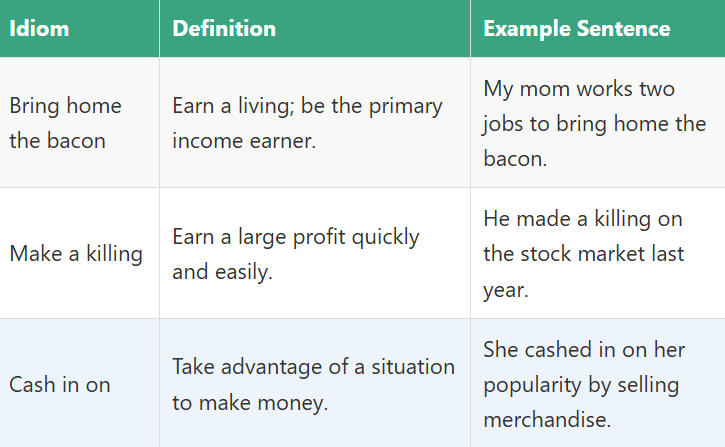
Table of Contents
- Definition of Money Idioms
- Structural Breakdown of Money Idioms
- Types and Categories of Money Idioms
- Examples of Money Idioms
- Usage Rules for Money Idioms
- Common Mistakes with Money Idioms
- Practice Exercises
- Advanced Topics in Money Idioms
- Frequently Asked Questions
- Conclusion
Definition of Money Idioms
A money idiom is a phrase or expression where the words used have a figurative meaning that differs from the literal meaning of the individual words. These idioms are used to describe financial situations, attitudes towards money, or the process of earning, spending, saving, or losing money. Understanding money idioms is essential for interpreting spoken and written English in various contexts, from casual conversations to formal business discussions.
Money idioms often reflect cultural values and historical contexts, providing insights into how societies perceive wealth, poverty, and financial responsibility. For example, an idiom like “living paycheck to paycheck” highlights the struggle of those with limited financial resources, while “born with a silver spoon in their mouth” describes someone who is born into wealth and privilege.
The function of money idioms is to add color, emphasis, and nuance to financial discussions. They allow speakers to convey complex ideas in a concise and memorable way.
In business, idioms can be used to soften potentially harsh financial realities or to add a touch of humor to otherwise serious topics. In everyday conversation, they can help people relate to each other’s financial experiences and express empathy or understanding.
Structural Breakdown of Money Idioms
Money idioms, like all idioms, do not follow standard grammatical rules. Their meaning is derived from the entire phrase rather than the individual words.
This means that the structure of a money idiom cannot be altered without changing its meaning or rendering it nonsensical.
Most money idioms consist of a combination of nouns, verbs, adjectives, and prepositions. The specific arrangement of these elements contributes to the idiom’s unique meaning.
For example, the idiom “break the bank” includes the verb “break” and the noun “bank,” but its meaning is not literally about damaging a financial institution. Instead, it means to cost too much money.
The grammatical structure of idioms can vary. Some idioms are phrases, while others are clauses or even complete sentences.
The key is that the idiom must be used as a unit, and its structure cannot be modified. Here are a few examples illustrating the structural elements:
- Verb + Noun: Break the bank (cost too much)
- Preposition + Noun: In the red (in debt)
- Adjective + Noun: Tighten your belt (spend less money)
- Noun + Verb: Money talks (money has influence)
Understanding the structural elements of money idioms helps learners recognize and remember them more easily. By analyzing the components of an idiom, one can better grasp its figurative meaning and usage.
Types and Categories of Money Idioms
Money idioms can be categorized based on the specific financial aspects they describe. Here are several key categories:
Idioms Related to Earning Money
These idioms describe the process of acquiring income or financial gains. They often reflect the effort, skills, or luck involved in earning money.
Idioms Related to Spending Money
These idioms pertain to the act of using money for goods, services, or other expenses. They can describe wise or unwise spending habits.
Idioms Related to Saving Money
These idioms focus on the practice of setting aside money for future use. They often emphasize frugality and financial planning.
Idioms Related to Financial Trouble
These idioms describe situations where individuals or organizations are facing financial difficulties, such as debt or bankruptcy.
Idioms Related to Financial Success
These idioms portray situations of wealth, prosperity, or financial achievement.
Examples of Money Idioms
The following sections provide extensive examples of money idioms, organized by category. Each example is accompanied by a definition and a sample sentence to illustrate its usage.
The tables below provide a structured overview of these idioms.
Idioms Related to Earning Money
These idioms describe the ways in which people earn money, often highlighting the effort, skills, or luck involved. From easy gains to hard-earned cash, these expressions paint a vivid picture of the working world.
Here’s a table with examples of idioms related to earning money:
| Idiom | Definition | Example Sentence |
|---|---|---|
| Bring home the bacon | Earn a living; be the primary income earner. | My mom works two jobs to bring home the bacon. |
| Make a killing | Earn a large profit quickly and easily. | He made a killing on the stock market last year. |
| Cash in on | Take advantage of a situation to make money. | She cashed in on her popularity by selling merchandise. |
| Golden handshake | A large sum of money given to someone when they leave a company. | The executive received a generous golden handshake upon retirement. |
| Line your pockets | Make money dishonestly or through corrupt means. | The politician was accused of lining his pockets with public funds. |
| Make ends meet | Have just enough money to cover expenses. | It’s hard to make ends meet on a minimum wage job. |
| Money for jam | Money earned easily, without much effort. | For him, consulting is money for jam. |
| Work your fingers to the bone | Work extremely hard. | She worked her fingers to the bone to pay off her student loans. |
| Sweat equity | Equity or ownership interest gained in exchange for labor or service rather than monetary investment. | He built his business through sweat equity, investing his time and effort. |
| Make a quick buck | To earn money quickly, often through dubious means. | He tried to make a quick buck by selling fake designer goods. |
| Turn a profit | To make more money than you spend. | The company managed to turn a profit despite the economic downturn. |
| Earn a crust | To earn enough money to live on. | He earns a crust as a freelance writer. |
| Make a fast buck | To earn money quickly, often in a way that is not honest. | They were trying to make a fast buck with their new scheme. |
| Get paid peanuts | To receive very little money for work. | She’s a highly skilled worker, but she gets paid peanuts. |
| Pick up the tab | To pay the bill for something, often for others. | He offered to pick up the tab for dinner. |
| Strike gold | To suddenly become very successful or wealthy. | The company struck gold with their latest product launch. |
| Be in the money | To be rich or have plenty of money. | Since he won the lottery, he’s really in the money. |
| Fall into money | To inherit money unexpectedly. | She fell into money when her uncle passed away. |
| Worth its weight in gold | Extremely valuable or useful. | A good accountant is worth their weight in gold. |
| Get a good deal | To obtain something at a favorable price. | We got a good deal on our new car. |
| Make a mint | To make a lot of money. | He made a mint selling his company. |
| Clean up | To make a large amount of money quickly. | They cleaned up at the casino last night. |
| Cash cow | A business or product that generates a lot of money. | Their new product is a real cash cow. |
| Feather your nest | To enrich oneself, often dishonestly. | He was accused of feathering his nest while in office. |
| Living high on the hog | Living luxuriously. | Since winning the lottery, they’ve been living high on the hog. |
| One’s bread and butter | A main source of income. | Freelance writing is my bread and butter. |
Idioms Related to Spending Money
These idioms describe how people spend their money, whether wisely or unwisely. They offer a colorful way to talk about shopping habits, financial decisions, and the value we place on different things.
Here’s a table with examples of idioms related to spending money:
| Idiom | Definition | Example Sentence |
|---|---|---|
| Burn a hole in your pocket | Money that one is tempted to spend quickly. | The money from my paycheck is burning a hole in my pocket. |
| Shell out | Spend money, often unwillingly. | We had to shell out a lot of money for car repairs. |
| Foot the bill | Pay for something, typically a large expense. | The company will foot the bill for the conference. |
| Dip into savings | Use money that has been saved. | We had to dip into our savings to cover the unexpected expenses. |
| Go Dutch | Each person pays their own way. | Let’s go Dutch on dinner tonight. |
| Live beyond your means | Spend more money than you earn. | They are living beyond their means with their lavish lifestyle. |
| Money is no object | Money is not a limiting factor. | For him, money is no object when it comes to his hobbies. |
| Pay through the nose | Pay a very high price. | We had to pay through the nose to get tickets to the concert. |
| Break the bank | Cost too much money. | That new car would break the bank. |
| Tighten your belt | Spend less money. | We need to tighten our belts and cut back on expenses. |
| Pour money down the drain | Waste money on something useless. | Buying that old car was like pouring money down the drain. |
| Be rolling in it | To be very rich. | Ever since he sold his company, he’s been rolling in it. |
| Blow money | To spend money carelessly. | He tends to blow money on unnecessary things. |
| Splash out | To spend a lot of money on something special. | We decided to splash out on a fancy dinner for our anniversary. |
| Fritter away | To waste money on trivial things. | He frittered away his inheritance. |
| Shell out (for something) | To pay money, usually when the payment is large or unexpected. | We had to shell out a lot for the car repairs. |
| Spend a fortune | To spend a lot of money. | We spent a fortune on our vacation. |
| A fool and his money are soon parted | Someone who is not careful with their money will lose it quickly. | He bought a flashy car he couldn’t afford, proving that a fool and his money are soon parted. |
| Bet your bottom dollar | To be absolutely sure. | I’d bet my bottom dollar that he’s going to win. |
| Cost an arm and a leg | To be very expensive. | Those designer shoes cost an arm and a leg. |
| Fork out | To spend money, especially when you don’t want to. | I had to fork out a lot for the new tires. |
| Go for a song | To be sold very cheaply. | The antique furniture went for a song at the auction. |
| In for a penny, in for a pound | Committed to continue with something even if it becomes difficult or costly. | We’ve started the project, so it’s in for a penny, in for a pound. |
| Money doesn’t grow on trees | Money is not easily obtained and should be valued. | Remember, money doesn’t grow on trees, so we need to be careful with our spending. |
| Money is the root of all evil | The pursuit of money can lead to bad things. | Some people believe that money is the root of all evil. |
Idioms Related to Saving Money
These idioms focus on the act of saving money and being frugal. They often highlight the importance of financial planning and avoiding unnecessary expenses.
Below is a table with examples of idioms related to saving money:
| Idiom | Definition | Example Sentence |
|---|---|---|
| Nest egg | Money saved for the future. | They have a substantial nest egg for their retirement. |
| Put away for a rainy day | Save money for a future time when it might be needed. | We should put away some money for a rainy day. |
| Squirrel away | To hide or save something, especially money. | She squirrels away a little bit of money each month. |
| Cut corners | To do something cheaply or inadequately. | They had to cut corners to stay within budget. |
| On a shoestring budget | Operating with very little money. | We managed to travel Europe on a shoestring budget. |
| A penny saved is a penny earned | Saving money is as valuable as earning it. | Remember, a penny saved is a penny earned. |
| Save for a rainy day | Save money for a future time when it might be needed. | It’s always wise to save for a rainy day. |
| Watch the pennies and the pounds will look after themselves | If you are careful with small amounts of money, you will accumulate larger amounts. | We’re trying to watch the pennies and the pounds will look after themselves. |
| Keep something for a rainy day | To save something, usually money, for a time when it might be needed. | I always try to keep some money for a rainy day. |
| Hold on to your hat | Get ready for something surprising or shocking. | The stock market is volatile, so hold on to your hat. |
| As good as money in the bank | Safe and reliable. | His promise is as good as money in the bank. |
| Have sticky fingers | To be a thief. | He was caught with sticky fingers at the store. |
| Keep your hand in your pocket | Avoid spending money. | We have to keep our hand in our pocket this month. |
| Live from hand to mouth | To have only enough money to live on. | They live from hand to mouth, barely making ends meet. |
| Look after the pennies and the pounds will look after themselves | If you are careful with small amounts of money, you will accumulate larger amounts. | We’re trying to look after the pennies and the pounds will look after themselves. |
| Scrimp and save | To save money by spending as little as possible. | They had to scrimp and save to afford their dream vacation. |
| Stash away | To hide or store something, especially money. | He stashed away some money in a secret account. |
| Think twice about spending money | To consider whether something is worth buying before spending money on it. | I always think twice about spending money on expensive clothes. |
Idioms Related to Financial Trouble
These idioms describe situations where individuals or organizations are experiencing financial difficulties, such as debt, bankruptcy, or poverty. They often convey a sense of desperation or hardship.
Here is a table with examples of idioms related to financial trouble:
| Idiom | Definition | Example Sentence |
|---|---|---|
| In the red | Operating at a loss; in debt. | The company has been in the red for the past two years. |
| Broke | Having no money. | I’m completely broke until payday. |
| Strap for cash | Having very little money available. | We’re a little strapped for cash at the moment. |
| Go belly up | To go bankrupt or fail financially. | The business went belly up after the recession. |
| Down and out | Having no money, no home, and no prospects. | He was down and out after losing his job. |
| Hand to mouth | Living with only enough money for basic needs. | They live hand to mouth, barely making ends meet. |
| On the breadline | Living in extreme poverty. | Many families are on the breadline due to unemployment. |
| Skint | Having no money (British slang). | I’m completely skint until I get paid. |
| Dead broke | Having absolutely no money. | After paying all his bills, he was dead broke. |
| Owe a fortune | To have a very large debt. | They owe a fortune in student loans. |
| Bad debt | Debt that is unlikely to be paid. | The company had to write off a lot of bad debt. |
| Go to the wall | To fail or be destroyed. | Many small businesses went to the wall during the pandemic. |
| In Queer Street | In financial difficulty. | The company has been in Queer Street since the scandal. |
| On its last legs | Near the end of its useful life. | The old car is on its last legs. |
| Penny-pinching | Being unwilling to spend money. | The company has been penny-pinching to save costs. |
| Rob Peter to pay Paul | To take money from one place to pay off a debt in another, creating more debt. | By taking a loan to pay off his credit card, he was just robbing Peter to pay Paul. |
| Sink into debt | To gradually accumulate more debt. | They sank into debt after losing their jobs. |
| Struggling to make ends meet | Having difficulty paying for basic needs. | Many families are struggling to make ends meet due to rising costs of living. |
Idioms Related to Financial Success
These idioms describe situations of wealth, prosperity, or financial achievement. They often convey a sense of abundance and luxury.
Here is a table with examples of idioms related to financial success:
| Idiom | Definition | Example Sentence |
|---|---|---|
| Born with a silver spoon in your mouth | Born into a wealthy family. | He was born with a silver spoon in his mouth and never had to worry about money. |
| Sitting pretty | In a comfortable or advantageous position, especially financially. | Now that they’ve paid off their mortgage, they’re sitting pretty. |
| Living the life of Riley | Living a luxurious and carefree life. | Since he won the lottery, he’s been living the life of Riley. |
| Flush with cash | Having a lot of money. | After the successful IPO, the company was flush with cash. |
| Rolling in dough | Very rich. | Since he sold his startup, he’s been rolling in dough. |
| In clover | Living comfortably and prosperously. | They’ve been in clover since their business took off. |
| Made of money | Very rich. | They can afford anything; they’re made of money. |
| Strike it rich | Become wealthy suddenly. | He struck it rich after discovering oil on his land. |
| Have deep pockets | To be wealthy. | The investor has deep pockets and can fund the entire project. |
| Laugh all the way to the bank | To earn a lot of money easily. | They’re laughing all the way to the bank after their successful product launch. |
| Land on one’s feet | To recover quickly from a setback. | Despite losing his job, he landed on his feet and found a better one. |
| Live in the lap of luxury | To live in very comfortable conditions. | They live in the lap of luxury in their mansion. |
| Be well-off | To be wealthy. | They’re quite well-off and can afford to travel frequently. |
| Have money to burn | To have so much money that you can spend it on anything. | They have money to burn and often buy extravagant things. |
Usage Rules for Money Idioms
Using money idioms correctly requires an understanding of their specific meanings and contexts. Here are some key usage rules:
- Context Matters: Use the idiom in a context that aligns with its figurative meaning. For example, “break the bank” should be used when discussing something that is too expensive, not when literally referring to damaging a bank.
- Word Order: Do not change the word order of the idiom. Idioms have a fixed structure, and altering it can change the meaning or make it nonsensical.
- Tense and Agreement: Adjust the tense and agreement of the idiom to match the sentence. For example, “He is bringing home the bacon” (present continuous) or “She brought home the bacon” (past simple).
- Audience Awareness: Be mindful of your audience. Some idioms may be unfamiliar to non-native speakers or inappropriate in formal settings.
- Avoid Overuse: While idioms can add color to your language, overuse can make your speech sound unnatural or contrived.
Common Mistakes with Money Idioms
Learners often make mistakes when using money idioms due to a misunderstanding of their figurative meanings or incorrect application of grammatical rules. Here are some common errors and how to avoid them:
- Literal Interpretation: Avoid interpreting idioms literally. Remember that the meaning of an idiom is different from the sum of its individual words.
- Incorrect: “He broke the bank” (literally damaged a bank).
- Correct: “The new car would break the bank” (cost too much).
- Incorrect Word Order: Do not change the word order of an idiom.
- Incorrect: “The bacon bring home.”
- Correct: “Bring home the bacon.”
- Misunderstanding the Meaning: Ensure you understand the correct meaning of the idiom before using it.
- Incorrect: “She’s in the black because she’s sad.” (confusing “in the black” with a literal meaning).
- Correct: “She’s in the black because her business is profitable.” (in the black means profitable).
The table below provides further examples of common mistakes and corrections:
| Common Mistake | Correct Usage |
|---|---|
| “He is making a kill” (incorrect word form) | “He is making a killing” (correct idiom usage) |
| “They are living beyond their incomes” (literal translation) | “They are living beyond their means” (correct idiom) |
| “She put money for a sunny day” (incorrect preposition) | “She put money away for a rainy day” (correct idiom) |
| “The company went stomach up” (incorrect idiom) | “The company went belly up” (correct idiom) |
Practice Exercises
Test your understanding of money idioms with these practice exercises. Choose the correct idiom to complete each sentence.
Exercise 1: Fill in the Blanks
- After the successful product launch, they were ____________.
- a) in the red
- b) laughing all the way to the bank
- c) on the breadline
- We had to ____________ to repair the damage from the storm.
- a) shell out
- b) bring home the bacon
- c) tighten our belts
- He ____________ a little bit of money each month for his retirement.
- a) breaks the bank
- b) squirrels away
- c) pours down the drain
- The company has been ____________ for the past year due to poor sales.
- a) in the red
- b) rolling in dough
- c) sitting pretty
- They are ____________ with their lavish spending habits.
- a) living beyond their means
- b) making ends meet
- c) tightening their belts
- She ____________ when her grandfather passed away.
- a) falls into money
- b) cleans up
- c) makes a killing
- He’s been ____________ since he lost his job.
- a) rolling in it
- b) down and out
- c) sitting pretty
- We need to ____________ if we want to save for a vacation.
- a) tighten our belts
- b) shell out
- c) bring home the bacon
- She ____________ to get her business off the ground.
- a) worked her fingers to the bone
- b) cleaned up
- c) struck gold
- I’m ____________ after paying all my bills.
- a) rolling in dough
- b) broke
- c) in clover
Answer Key:
- b) laughing all the way to the bank
- a) shell out
- b) squirrels away
- a) in the red
- a) living beyond their means
- a) falls into money
- b) down and out
- a) tighten our belts
- a) worked her fingers to the bone
- b) broke
Exercise 2: Match the Idiom to Its Definition
| Idiom | Definition |
|---|---|
| 1. Bring home the bacon | a. To cost too much money |
| 2. Break the bank | b. To have very little money available |
| 3. Strap for cash | c. To earn a living |
| 4. Money doesn’t grow on trees | d. Save money for a future time when it might be needed. |
| 5. Save for a rainy day | e. Money is not easily obtained and should be valued. |
Answer Key:
- 1 – c
- 2 – a
- 3 – b
- 4 – e
- 5 – d
Advanced Topics in Money Idioms
For advanced learners, exploring the etymology and cultural context of money idioms can provide a deeper understanding of their usage. Many money idioms have historical roots that reflect past economic conditions and social attitudes.
For example, the idiom “born with a silver spoon in your mouth” dates back to a time when silver spoons were a luxury item, symbolizing wealth and privilege.
Additionally, understanding regional variations in money idioms can enhance your ability to communicate effectively in different English-speaking countries. Some idioms may be more common in British English than in American English, or vice versa.
For instance, “skint” is a British slang term for being broke, while “broke” is more commonly used in American English.
Analyzing the use of money idioms in literature, film, and media can also provide valuable insights into their figurative meanings and cultural significance. Pay attention to how authors and filmmakers use idioms to convey character traits, create humor, or add depth to their stories.
Frequently Asked Questions
- What is the difference between an idiom and a proverb?An idiom is a phrase whose meaning is different from the literal meanings of its individual words (e.g., “break the bank”). A proverb is a short, well-known saying that expresses a general truth or piece of advice (e.g., “a penny saved is a penny earned”).
- How can I learn money idioms effectively?Immerse yourself in English language content, such as books, movies, and conversations. Keep a notebook of new idioms and their meanings, and practice using them in
your own sentences. Use flashcards or language learning apps to reinforce your knowledge. - Are money idioms used in formal writing?While idioms can add color to your writing, they are generally more appropriate in informal or creative contexts. In formal writing, it’s best to use clear, direct language to avoid ambiguity.
- How do I know when to use a money idiom?Consider your audience and the context of your communication. If you’re unsure whether an idiom is appropriate, it’s better to err on the side of caution and use more straightforward language.
- Can the meaning of money idioms change over time?Yes, like all language, the meanings and usage of idioms can evolve over time. It’s important to stay updated on current usage and be aware of any shifts in meaning.
Conclusion
Money idioms are an integral part of the English language, providing a colorful and nuanced way to discuss financial matters. By understanding their meanings, origins, and usage rules, you can enhance your communication skills and gain a deeper appreciation for the richness of the English language.
Whether you’re a student, a business professional, or simply an English enthusiast, mastering money idioms will undoubtedly enrich your linguistic toolkit.